

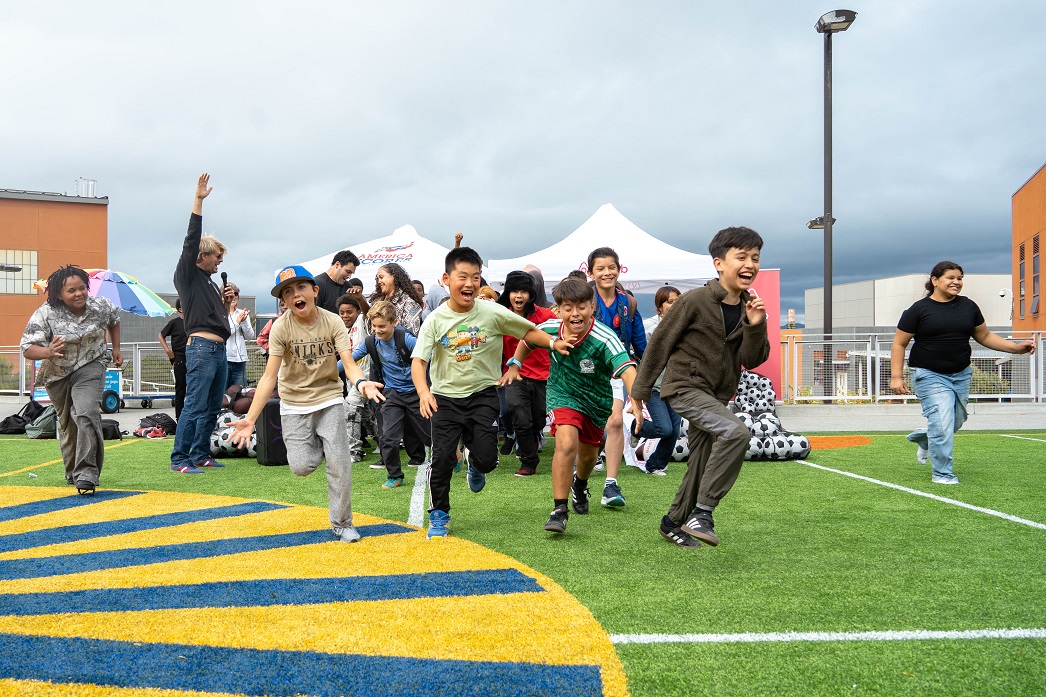
Helping Playing for Keeps Deliver School Turf Fields in SF
Closing Play Deserts: TenCate Builds Turf Fields at 14 San Francisco Schools
In many San Francisco neighborhoods, the schoolyard is asphalt. For children without a nearby park, that hard surface is often the only place to run or join a game. These areas are known as "play deserts": communities where children have little or no access to quality places to play.
TenCate is part of an effort to change that. As a member of the Playing for Keeps Foundation, TenCate supports a partnership with America SCORES Bay Area to create or upgrade synthetic turf fields at 14 San Francisco public schools. Every project uses or will use TenCate Pivot® Performance Turf.
Why School Play Space Matters
For many children, the school field is the most reliable place to play. It is close to home, open during the school day and used for after-school programs. When that space is cracked asphalt, fewer games happen and fewer children take part.
Schools also face practical limits. Play spaces see heavy daily use, and maintenance budgets are often tight. A field only helps if it stays available, season after season.
TenCate's Role in Playing for Keeps
The Playing for Keeps Foundation brings together philanthropy, industry, schools and youth organizations. Its goal is to fund play infrastructure in communities that lack dependable places to play, and to support programming that keeps those spaces in use.
TenCate takes part as a member of the foundation. In San Francisco, that role centers on the playing surface. The 14 projects rely on TenCate Pivot Performance Turf, along with TenCate's experience in how surfaces perform in real, high-use settings.
A Surface Selected for School Use
Pivot Performance Turf is a fiber-filled surface. The partners selected it for durability, consistent playing conditions and routine maintenance requirements.
Each of these factors connects to access. Durability matters because school fields host recess, physical education and after-school sport every day. Consistent playing conditions help children play the same way from one week to the next. Manageable maintenance helps schools with limited budgets keep fields open throughout the school year.
At the end of its useful life, the system is eligible for the TenCate Turf Recycling Program.
The Scope of the San Francisco Projects
The 14 projects represent about $1.9 million in investment in San Francisco school play spaces. The partners project the fields will benefit more than 4,000 students each year over the next decade. Together, the fields cover more than 100,000 square feet, roughly the area of two full-size football fields.
The Herbst Foundation and Airbnb are among the funders. Schools receive the fields at no cost.
Six projects have already replaced asphalt schoolyards with new fields, and students are using them today. Eight more are planned or underway through 2027: one new field and seven turf replacements.
New fields, completed: Harvey Milk Civil Rights Academy, New Traditions Creative Arts Elementary School, Monroe Elementary School, Willie L. Brown Jr. Middle School, Malcolm X Academy Elementary School and Sherman Elementary School.
Replacement fields scheduled this year: Sanchez Elementary School, Hillcrest Elementary School and Tenderloin Community Elementary School.
Replacement fields scheduled for 2027: Marshall Elementary School, Bret Harte Elementary School and Paul Revere (PreK-8) School.
Replacement field, timeline to be determined: E.R. Taylor Elementary School.
New field, site and timeline to be announced: one additional San Francisco middle school.
Working With Local Partners
A surface is one part of the picture. Fields deliver value when children use them regularly.
America SCORES Bay Area brings that local connection. Over more than a decade, its Field of Dreams program has completed 35 asphalt-to-turf conversions across the Bay Area. The organization also runs free after-school programs that combine soccer, poetry and community service for children in under-resourced schools.
This combination of surface, funding and programming is what turns a new field into lasting access to play.
Planning for the Long Term
Seven of the 14 projects replace existing turf. This reflects a practical reality. Every playing surface has a useful life. Long-term access depends on planning for renewal, not only the initial build.
Lifecycle performance is therefore part of the conversation from the start. That includes how a surface holds up under daily use, how it is maintained and what happens to the materials at end of life.
What This Means for Communities
Six San Francisco schoolyards that were asphalt are now playing fields. Eight more projects will follow by 2027.
The model is straightforward. Local partners identify where play space is missing. Philanthropic and industry members, including TenCate, help deliver the fields. Ongoing programming keeps them in use. Usage and availability over the coming years will show how fully the model delivers on its goals.