

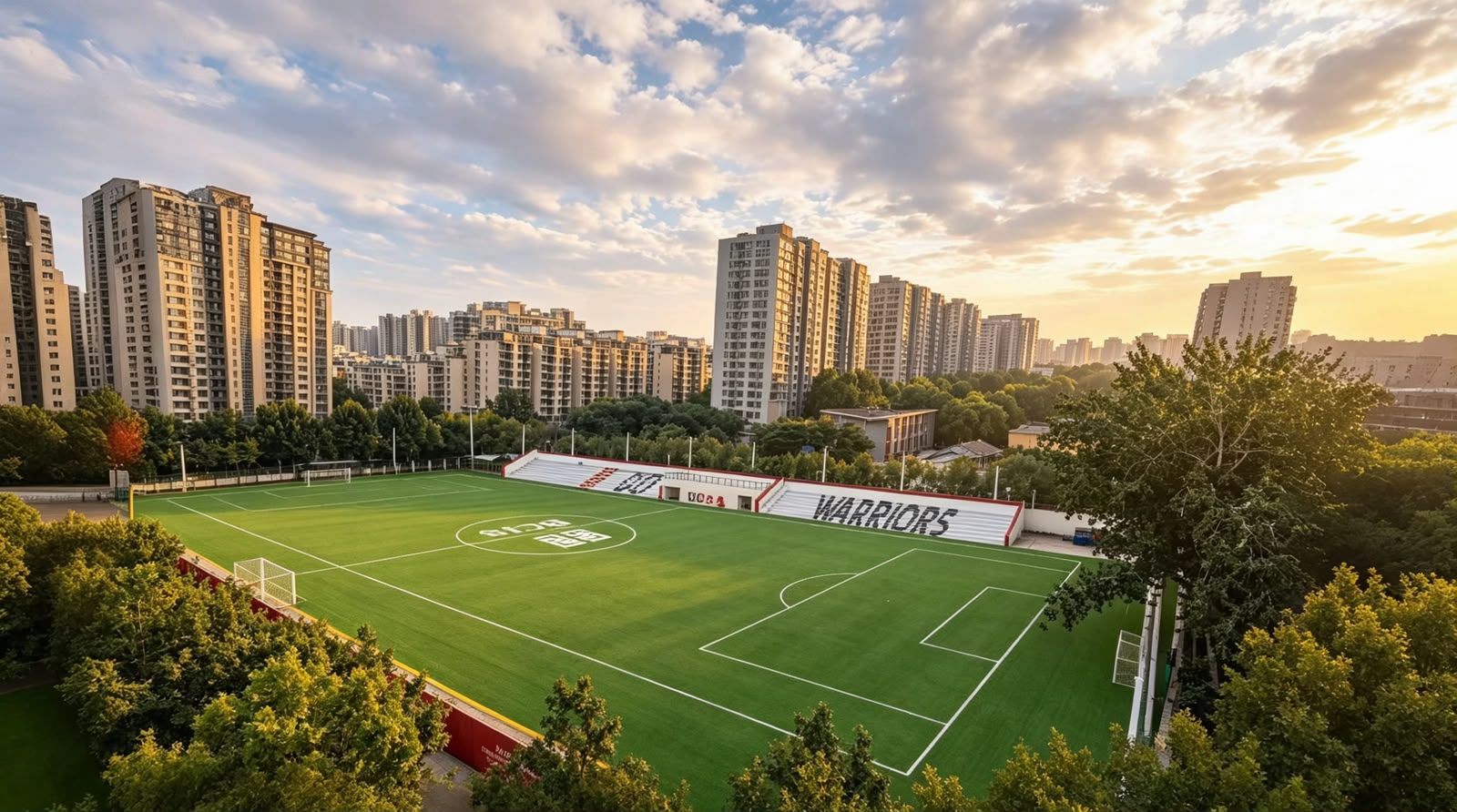
China’s First Infill Free FIFA Quality Field, in the Heart of Beijing
In a city where space comes at a premium, creating more opportunities for sport does not always mean finding more land. Sometimes it means getting more playing time from the space already available.
At Beijing City International School, that challenge is very real.
Located in Beijing’s Chaoyang District, in the heart of the Central Business District, BCIS serves more than 1,300 students from over 30 countries and regions. Sport has a significant place in school life, with students participating in competitions across Beijing, China and the wider region through ISAC, ACAMIS and JISAC. At its city campus, all that activity comes down to one full size outdoor sports field.
The field is used intensively for football and other sporting activities throughout the school week. There is no second full size field to absorb that demand. The amount of space available is fixed. That makes every playing hour valuable.
More playing time from the space already there
BCIS recently replaced its existing surface with Pure PT™ 38, an infill free turf system developed by TenCate and installed by Beijing Borun Sport. Performance was an important requirement. FIFA Quality certification was mandatory for the project and, following installation and testing, the complete Pure PT™ 38 field achieved FIFA Quality certification. This makes it the first infill free field in China to achieve FIFA Quality certification. The certified Pure PT™ 38 system achieves the required performance without infill or a shockpad. No rubber. No sand.
But in a location like this, performance is only part of the equation. Availability matters too. Pure PT™ creates its playing characteristics without infill. There is therefore no infill to migrate and no need for infill redistribution, decompaction or replenishment. Routine field care remains necessary, but these activities associated specifically with loose infill are removed. For a school relying on one field for intensive daily use, that supports something very practical: keeping valuable sports space available for play.
A question facing cities everywhere
The situation at BCIS reaches beyond one school. As urban areas become denser, finding additional space for sport becomes increasingly difficult. At the same time, the need for places where people can move, train and play remains. That changes the way sports infrastructure needs to be considered.
The relevant measure is not only how many square metres are available. It is also how many useful playing hours those square metres can support. Adding capacity does not always require more land. It can also mean making existing facilities more available and reducing operational demands that can take them out of use.
Making limited space count
At BCIS, that principle becomes tangible. More than 1,300 students. One full size outdoor field. And a sports programme that extends from everyday school activity to competition with other international schools.
Now that field is also China’s first infill free FIFA Quality field, combining intensive multipurpose use with independently tested football performance.
In a city where additional space is difficult to find, protecting the availability of the space that already exists becomes increasingly important. BCIS is one school, but the principle is much broader. In dense cities, sports capacity is not only a question of how much space exists. It is also a question of how often that space can be used.